
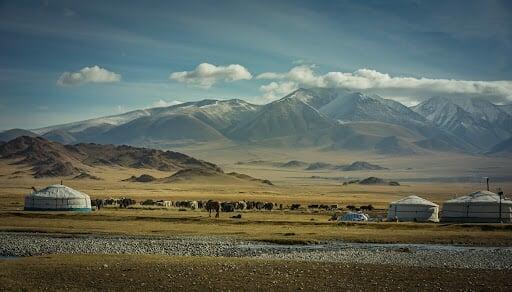
When people live far apart, hospitality becomes part of how the community functions. A traveler may need directions or information. More commonly, they may be searching for lost cattle or horses. It is expected to host them with tea, food, and even a place to rest. Travelers can arrive at any hour, including late at night, and are traditionally welcomed and fed. Because it happens to you, too. One day, you are the host. Another day, you may be the traveler looking for help. Over generations, welcoming visitors became part of nomadic culture. That tradition remains alive today.
Why Nomads Welcome Strangers
For most of history, people traveled long distances across open grasslands with few permanent settlements. In such an environment, hospitality was practical as much as it was cultural. A visitor might bring news from another region. A traveler might need help. The people moving across the steppe were often the source of the latest information.
Naturally, visits were often unexpected. Yet there was sometimes a warning. Many nomads will tell you that the magpie often announces an approaching guest before they arrive. The bird appears near the ger and begins chattering loudly. People have observed this for generations. The explanation is uncertain. Perhaps the magpie notices an approaching rider and understands where the rider is headed. Whatever the reason, many families still smile when the magpie begins making noise.
Traditionally, fresh milk was available every day during summer, while refrigeration did not exist. As a result, dairy products made up a large part of the seasonal diet. When guests arrived, however, families often prepared a hot meal using dried meat, known as borts. Many children secretly hoped for visitors because it meant there would be a hot dinner that evening.
Approaching a Ger
There are often signs that a family is nearby long before the ger comes into view. Grazing horses and cattle usually remain within a reasonable distance of home. Smoke from the stove may also be visible across the nomadic steppe.
When visitors finally arrive, the family's dog often announces them first. The barking informs the household that someone is approaching. If the dog is away following livestock, visitors may call out from outside to announce their arrival. One practical detail often surprises visitors. Nomadic families have traditionally not locked their doors. When family members are away herding livestock or working outside, the ger may remain open. To many modern travelers, this feels unusual. But for generations, trust and hospitality have been fundamental parts of life on the steppe.
Inside the Ger
From the outside, a ger appears simple. Inside, it is remarkably organized. Every item has a purpose. Beds, storage, cooking equipment, saddles, clothing, tools, and family belongings are arranged efficiently so the home remains practical, comfortable, and portable. Visitors often notice that the space feels larger than expected. Natural light enters through the roof opening. Furniture is arranged around the circular walls. The stove usually occupies a central position, providing warmth during Mongolia's long winters. Many traditional customs govern where people sit, move, and place their belongings. You do not need to memorize every detail before your visit. The simplest approach is also the best one: follow your host's lead. If offered a seat, take it. If you are uncertain, ask. Most hosts understand that foreign visitors are unfamiliar with local customs and appreciate sincere efforts to be respectful.
Food, Tea, and Hospitality
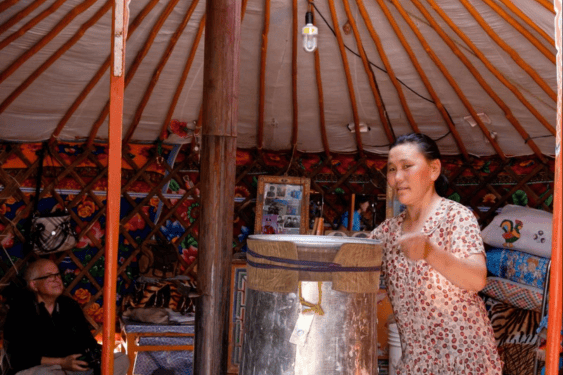
One of the first things offered to many visitors is tea.
Milk tea, known as suutei tsai, remains a daily part of life for many nomadic families. Depending on the season and region, visitors may also be offered dairy products, bread, snacks, dried curds, or other traditional foods.
For first-time visitors, some flavors may be unfamiliar. The important thing to understand is not the food itself, but what it represents. Offering food and drink is an expression of hospitality.
Accepting at least a small amount is often appreciated. You do not need to eat everything placed before you, but showing willingness to participate in the exchange demonstrates respect for your host's generosity. Many visitors arrive expecting to learn about livestock, migration, or traditional homes. Instead, they remember sharing tea around the stove.
Common Etiquette
The first important etiquette rule is simple, do not immediately refuse tea or snacks. The snacks are often homemade dairy products, fresh butter, cheese, fried pastries, or dried curds. For many visitors, they turn out to be more enjoyable than expected because they are fresh and made by the family themselves. If you are a foreign visitor, hosts are generally forgiving. They understand that you may not know every custom. If you would like to take photographs, it is good practice to ask first. Most families are happy to share aspects of their lives with respectful visitors, but it is important to remember that you are visiting a home, not a museum.
Good etiquette in Mongolia is less about memorizing rules and more about showing awareness, patience, and respect.
Visiting a Nomadic Family Is About Everyday Life
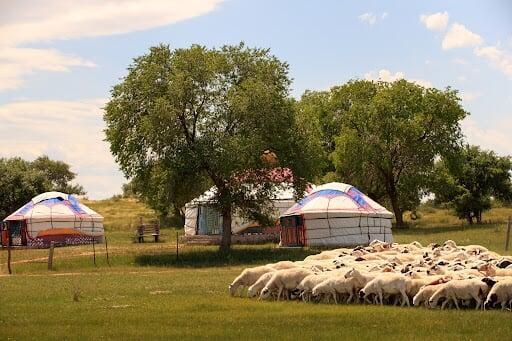
Many visitors arrive expecting a cultural performance or a carefully prepared tourist experience. Instead, what they usually encounter is ordinary daily life. Someone may be milking animals, preparing tea, repairing equipment, or tending livestock. Children come and go. Family members continue their work while welcoming guests into the home. This is part of what makes the experience memorable for travelers interested in Mongolia tourism.
A visit to a nomadic family is not simply about seeing a traditional ger. It is an opportunity to observe how people live in one of the world's last remaining pastoral cultures. The details are often simple: how food is prepared, how the ger is organized, how livestock are managed, and how hospitality functions in a place where neighbors may live many kilometers apart. For many travelers, these everyday moments provide a better understanding of nomadic life than any museum or exhibit could offer.